
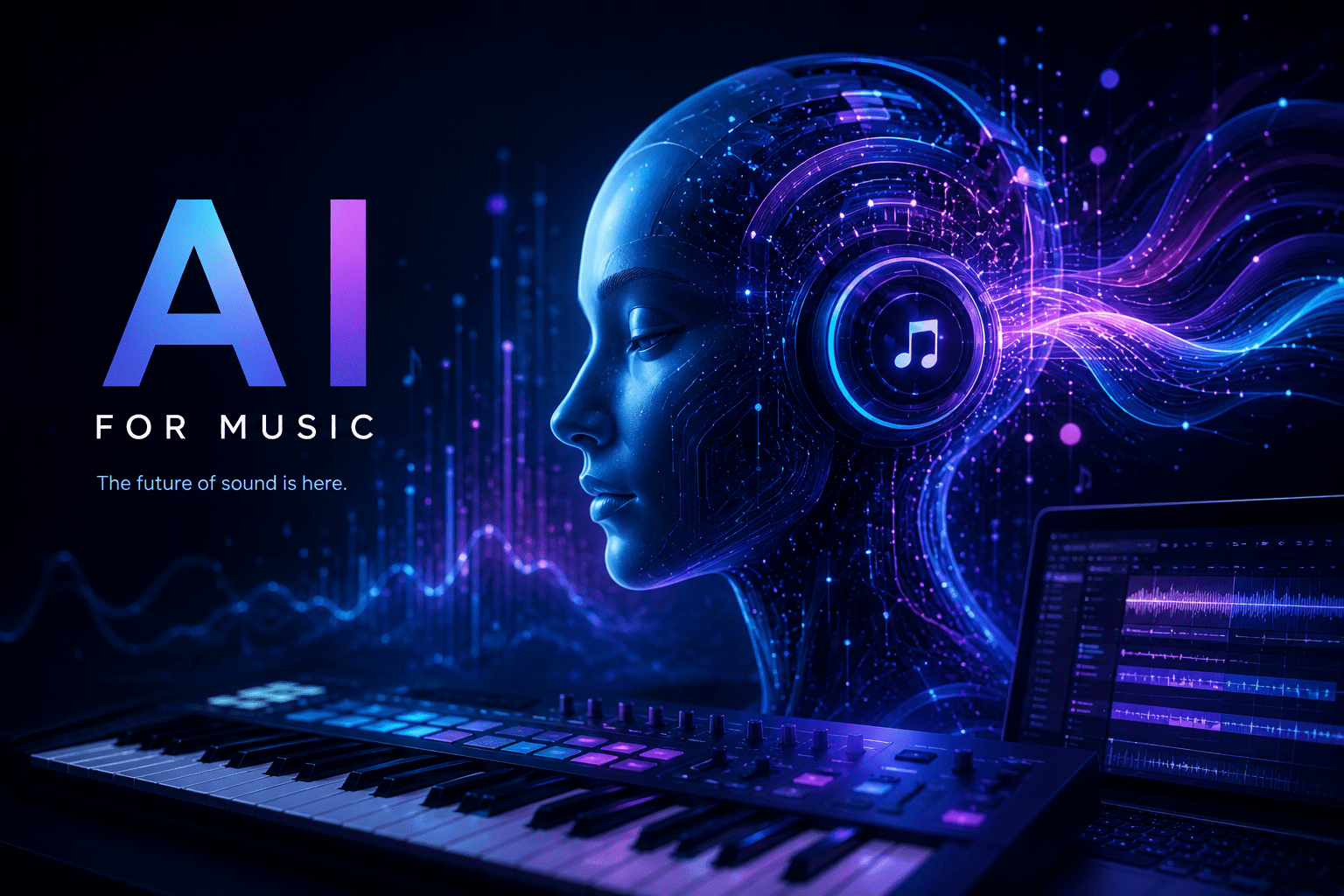
The New Maestro: AI for Music Composition in 2026
The landscape of professional and hobbyist music production has undergone a seismic shift. By 2026, the integration of AI for music composition has moved beyond novelty “song generators” into the realm of essential creative partnership. Musicians today no longer view artificial intelligence as a replacement for human soul, but as an advanced instrument—a digital collaborator capable of bridging the gap between a fleeting idea and a polished final mix.
From Algorithmic Mimicry to Creative Synthesis
Early versions of music AI were limited to predictive pattern matching, often producing generic, repetitive motifs. In 2026, the technology has reached a level of sophistication defined by “intent-based composition.” Modern AI models now understand musical theory, emotional context, and structural nuance.
Instead of asking a computer to “make a song,” a producer can now feed the software a specific set of emotional parameters, chord progressions, or even a hummed melody, and receive a composition that aligns with their unique stylistic fingerprint. The AI acts as a sophisticated force multiplier, allowing artists to iterate through harmonic possibilities in seconds that previously would have taken hours to arrange manually.
Essential AI Tools Shaping the Industry
The current ecosystem of tools has matured into three primary categories that define the modern studio workflow:
- Intelligent Generative Engines: These platforms allow artists to generate high-fidelity stems—from orchestral swells to intricate drum patterns—that can be manipulated in real-time.
- Neural Audio Restoration and Separation: By 2026, the ability to isolate individual tracks from legacy recordings or field samples is flawless, opening up endless sampling possibilities for creative sound design.
- Dynamic Mixing Assistants: AI-driven EQs, compressors, and spatial mixers now analyze the frequency spectrum of a project to suggest mix balances that ensure clarity across all playback systems, from professional monitors to smartphone speakers.
The Role of the “Human in the Loop”
Despite these advancements, the human element remains the heartbeat of the creative process. In 2026, the most successful composers are those who treat AI for music composition as a tool for rapid prototyping and idea refinement.
The computer excels at permutations, rapid transposition, and the technical heavy lifting of arrangement, but it lacks the lived experience required to imbue a track with genuine tension and release. The “human in the loop” methodology is now the industry standard: the AI provides the raw, technically perfect building blocks, while the human composer curates, edits, and adds the idiosyncratic “mistakes” and expressive variations that make music resonate with an audience.
Overcoming the “Generic Sound” Trap
One of the biggest criticisms of early AI music was the homogenization of sound. In 2026, sophisticated users combat this by training custom models on their own back-catalogs or specific niche sound libraries. By feeding the AI personal stems, field recordings, and proprietary synthesizer presets, artists ensure that the output remains entirely unique to their brand.
The most innovative producers are moving away from stock AI templates and toward “private ecosystems,” where the AI is essentially an extension of their personal sonic history. This approach ensures that while the workflow is accelerated by artificial intelligence, the creative output remains unmistakably human.
The Future of Sonic Expression
As we look further into the horizon, the marriage of AI and music composition is expanding into real-time performance. In 2026, live concert setups often include AI-driven accompaniment that reacts to a performer’s energy, tempo changes, and improvisational choices in real-time. This dynamic interaction creates performances that are unique to every single night, effectively bringing the improvisational spirit of jazz into the digital electronic domain.
Ultimately, the goal of using AI for music composition is not to remove the musician from the studio. It is to remove the barriers that prevent a musician from realizing their full potential. By automating the technical overhead and providing a virtually infinite canvas of possibilities, AI has allowed for a new golden age of creativity where the only real limitation is the artist’s imagination. In this new era, the composition process is no longer a struggle against technical constraints; it is a conversation between the spark of human inspiration and the limitless potential of the machine.


Leave a Reply